A cake can be beautifully decorated, perfectly finished, and carefully prepared… and still make a poor impression if it arrives in a weak or badly fitted box.
For bakeries, cake packaging has two jobs.
It needs to protect the product and present the brand.
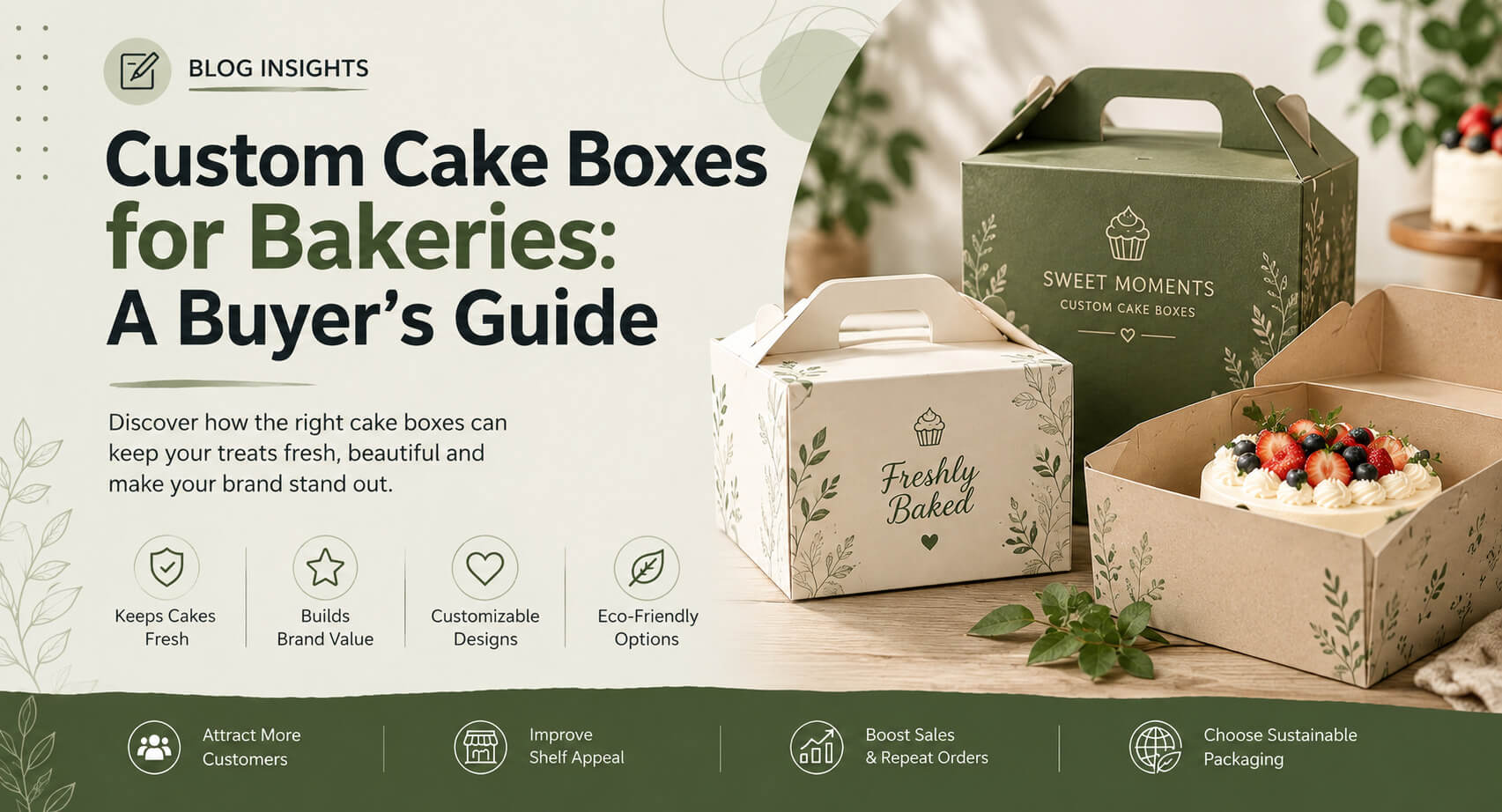
That sounds simple, but choosing the right custom cake box involves more than putting a logo on cardboard. Box dimensions, material, construction, printing, cake height, handling, and even the way customers carry the package can affect the final result.
For bakeries ordering packaging in bulk, getting these details right can save money and reduce avoidable packaging problems.
This guide explains what to consider before buying custom cake boxes, from size and material to branding and supplier selection.
Why Does Cake Box Design Matter for Bakeries?
Cake packaging is part of the customer experience.
When someone orders a birthday cake, wedding cake, anniversary cake, or celebration cake, they are buying more than a dessert. They are often buying something for an occasion.
The packaging needs to respect that.
A box that is too large can allow the cake to move around during handling. A box that is too small can press against the decoration. A weak base can make carrying the cake uncomfortable or risky.
Then there is the branding.
A custom printed box can put the bakery’s name, logo, colours, and visual identity directly into the customer’s hands.
That makes the packaging useful beyond protection… it becomes part of how the bakery is remembered.
1. Start With the Cake Size
The first mistake many businesses make is choosing a box based only on the cake’s weight.
Weight matters, but it is not enough.
You also need to consider:
- Cake diameter or length
- Cake height
- Decoration height
- Cake board dimensions
- Number of tiers
- Available clearance
- Base stability
- Whether the cake will be transported over a short or longer distance
For example, a tall 1 kg cake can require a very different box from a low-profile 1 kg cake.
This is why bakeries should provide actual product dimensions to the packaging manufacturer instead of ordering purely by weight.
What Cake Box Sizes Should a Bakery Keep?
There is no universal size range that works for every bakery.
Your product mix should determine the sizes.
Bag Bee states that its cake boxes are available in sizes designed to accommodate 0.5 kg, 1 kg, and 2 kg cakes, along with different shapes and configurations.
For a bakery, it can be useful to build a packaging range around its most frequently sold products.
For example:
- Small boxes for individual or smaller cakes
- Medium boxes for common celebration cakes
- Larger boxes for bigger cakes
- Taller configurations for cakes with substantial decoration
- Special sizes for tiered or customised cakes
The goal is to avoid using one oversized box for everything.
2. Choose the Right Material
Material selection affects the box’s strength, appearance, cost, and suitability for the application.
For cake packaging, the material needs to maintain its shape and provide sufficient support during normal handling.
The right specification can depend on:
- Cake weight
- Box dimensions
- Structural design
- Moisture exposure
- Transportation requirements
- Printing requirements
- Desired appearance
- Budget
The supplier should be able to explain the material and construction being proposed rather than simply quoting a price per box.
3. Think About the Cake Base
The box and cake base work together.
The cake board needs to sit properly inside the box without excessive movement.
If the base is too small for the box, the cake may shift during carrying. If the fit is too tight, positioning the cake can become difficult.
A good packaging specification therefore considers:
cake + cake board + box dimensions… as one system.
Bag Bee also lists cake bases among its product categories, which can be useful for businesses looking to coordinate their cake packaging requirements.
4. Decide Whether You Need a Handle
A handle can make a significant difference to customer convenience.
Think about the typical purchase.
A customer walks into a bakery, collects a cake, gets into a car, carries it upstairs, or takes it to a celebration.
A handle can make the box easier to carry in these situations.
However, the handle design needs to be appropriate for the box and the product weight.
The handle should not be treated as a decorative feature alone.
It is a functional part of the packaging.
Bag Bee offers cake boxes with handle configurations as one of its cake box types.
5. Custom Printing Turns Packaging Into Branding
This is where custom cake boxes become particularly valuable for established bakeries.
A plain box protects the product.
A branded box can do that while communicating who made it.
Your packaging can include:
- Bakery logo
- Brand colours
- Tagline
- Website
- Phone number
- Social media handle
- Product category
- Occasion-specific artwork
- Simple care or handling instructions
Also Read: Why Customers Keep Reusing Some Shopping Bags – And Throw Away Others
Common Mistakes When Buying Custom Cake Boxes
Ordering only by cake weight
Two cakes with the same weight can have very different dimensions.
Ignoring cake height
Decorations and tall designs need enough vertical clearance.
Using an oversized box
Too much empty space can allow unnecessary movement during handling.
Choosing packaging only by price
The cheapest unit price does not always provide the best overall value.
Approving artwork without checking it
A spelling mistake on thousands of boxes is an expensive correction.
Ordering too much too soon
Branding, product sizes, and seasonal demand can change.
Not discussing the actual application
Your supplier needs to know what type of cake the box will carry and how customers will handle it.
Why Experience Matters in Custom Packaging
Custom packaging is partly a design exercise and partly a manufacturing exercise.
You need both.
A supplier may create an attractive artwork but struggle to produce consistent boxes. Another may manufacture reliable boxes but provide limited customisation.
For bakeries, the ideal supplier should understand both sides… how packaging needs to look and how it needs to function.
Bag Bee has years of experience in manufacturing products including cake boxes, paper bags, cloth bags, jute bags, cotton bags, non-woven bags, and more. We serve clients across India and work with industries including bakeries, hotels, sweet and dry fruit shops, restaurants, and others.