You’ve seen it at home. A pile of bags in a kitchen drawer. Or stuffed behind a door. Or hanging from a hook somewhere near the entrance.
Some of those bags have been there for months. Maybe years. Others… lasted one trip from the shop to the house and went straight into the bin.
The question worth asking – especially if you run a retail business – is which bag is yours. And why.
Because the difference between a bag that gets kept and a bag that gets thrown away isn’t random. There’s a pattern to it. And understanding that pattern is genuinely useful if you’re thinking about packaging decisions for your business.
The Throw-Away Bag. What Makes It Disposable.
Think about the bags that don’t survive. Thin polythene. Single-use plastic. The kind that stretches when you put something heavy in it and tears at the handle before you’ve made it to the car.
These bags get discarded because they offer nothing beyond the immediate transaction. They carry the item from counter to customer. That’s it. The moment that function is complete… the bag has no further value. No structural strength to reuse. No aesthetic reason to keep. No brand message worth preserving.
The decision to throw it away takes about two seconds. Sometimes less.
Paper bags can fall into this category too – if they’re made from thin, uncoated paper that goes soft at the first sign of moisture. If the handles are weak. If the printing is faded or the construction is careless. A bad paper bag doesn’t survive the walk to the car, let alone a second use.
The physical quality of the bag is the first filter. Before anything else… the bag has to hold up.
The Kept Bag – What Makes It Worth Holding Onto.
Now think about the bags you’ve personally kept. The ones that are still in the house months later.
In most cases, they share a few characteristics.
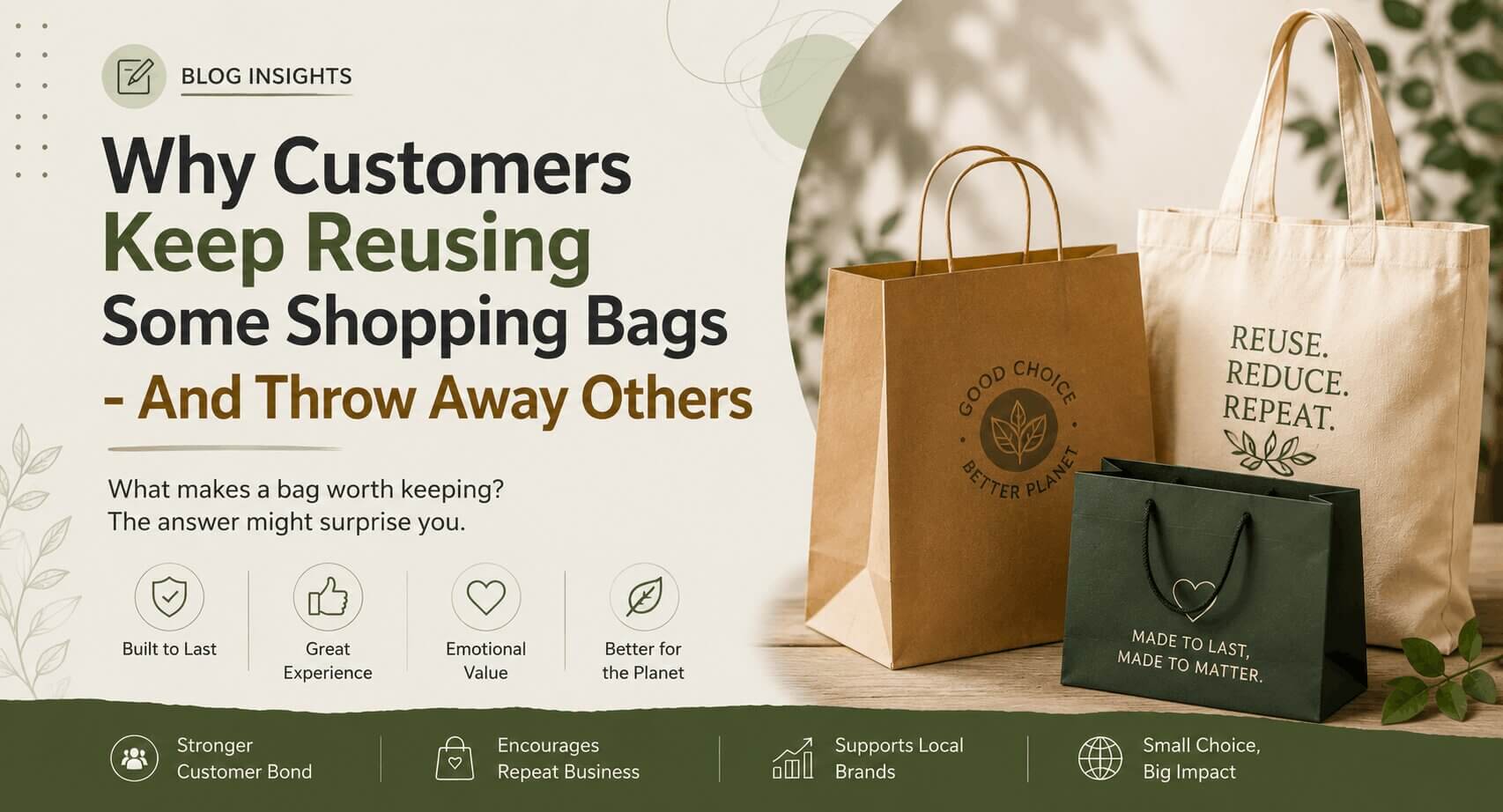
- They’re structurally sound: Thick paper, reinforced handles, proper gusseting. A bag that holds weight without straining doesn’t get thrown away because it still has obvious utility. It can carry something tomorrow. Next week. Next month.
- They look good: This is harder to quantify, but it’s real. A bag with a clean design, a well-printed logo, colours that hold – this is a bag that doesn’t embarrass the person carrying it. In fact… it might be a bag they’re comfortable being seen with. That matters more than most business owners think.
- They carry a brand worth displaying: A bag from a shop the customer likes, trusts, or feels some affinity with – that bag becomes a small statement. About taste. About where they shop. About what they value. People keep these bags and reuse them not just because they’re functional… but because they mean something.
- They have a clear second use: A well-made non-woven bag becomes a grocery bag, a gym bag, a bag-within-a-bag for carrying things on a commute. A sturdy paper bag becomes storage, gift wrapping, drawer lining. The kept bag is the one that suggests its own next purpose without the customer having to think too hard about it.
The Reuse Decision Happens Fast. And It’s Mostly Subconscious.
Here’s something worth understanding. Customers don’t stand at the bin and consciously evaluate your bag against a set of criteria.
The decision is faster than that. Almost instinctive.
A bag that feels cheap signals disposability before the customer has had time to think about it. The lightness of the material, the flimsiness of the handle, the faded print – all of these communicate “this is temporary” without a word being said.
A bag that feels solid signals the opposite. That this is an object. That it has continued value. That throwing it away would be a small waste.
The bag communicates its own fate in the moment the customer picks it up at the counter. Your job – as the business providing it – is to make sure that communication goes the right way.
What This Means for Your Business Specifically
If your bag is being thrown away after one use, you’re losing something.
Not just the bag. You’re losing the passive advertising that a reused bag provides every time it travels through a market, an office, a building lobby. You’re losing the brand recall that comes from a customer seeing your name every time they reach into a drawer. You’re losing the referral opportunity that happens when someone asks “Where did you get that bag?”
The bags that stick around are the ones that earn their place. And the way a bag earns its place is through quality… design… and the sense that the business behind it thought about more than just getting the product out the door.
That’s not an expensive thing to achieve. It’s a considered thing.
A thicker paper. A reinforced handle. A clean logo on a well-chosen colour. Consistent printing. These are not dramatic upgrades. But they push a bag from the disposable category into the kept category. And the difference in what that means for your brand – in visibility, recall, and the quiet impression it leaves – is significant.
The Takeaway
Customers don’t consciously decide to keep or throw away a bag. They feel it. In the weight of the material. The confidence of the handle. The look of the print.
A bag that feels worth keeping… gets kept. And every time it gets reused, it’s working for your business. Quietly, consistently, without any additional cost on your part.
A bag that feels disposable… gets disposed of. And with it goes every impression it might have made.
The bag your customer walks out with is a choice. Make the right one.
Bag Bee manufactures custom paper bags, non-woven bags, and cloth bags in Mumbai & Thane – built to last beyond the first use. Get in touch for bulk pricing and samples.