
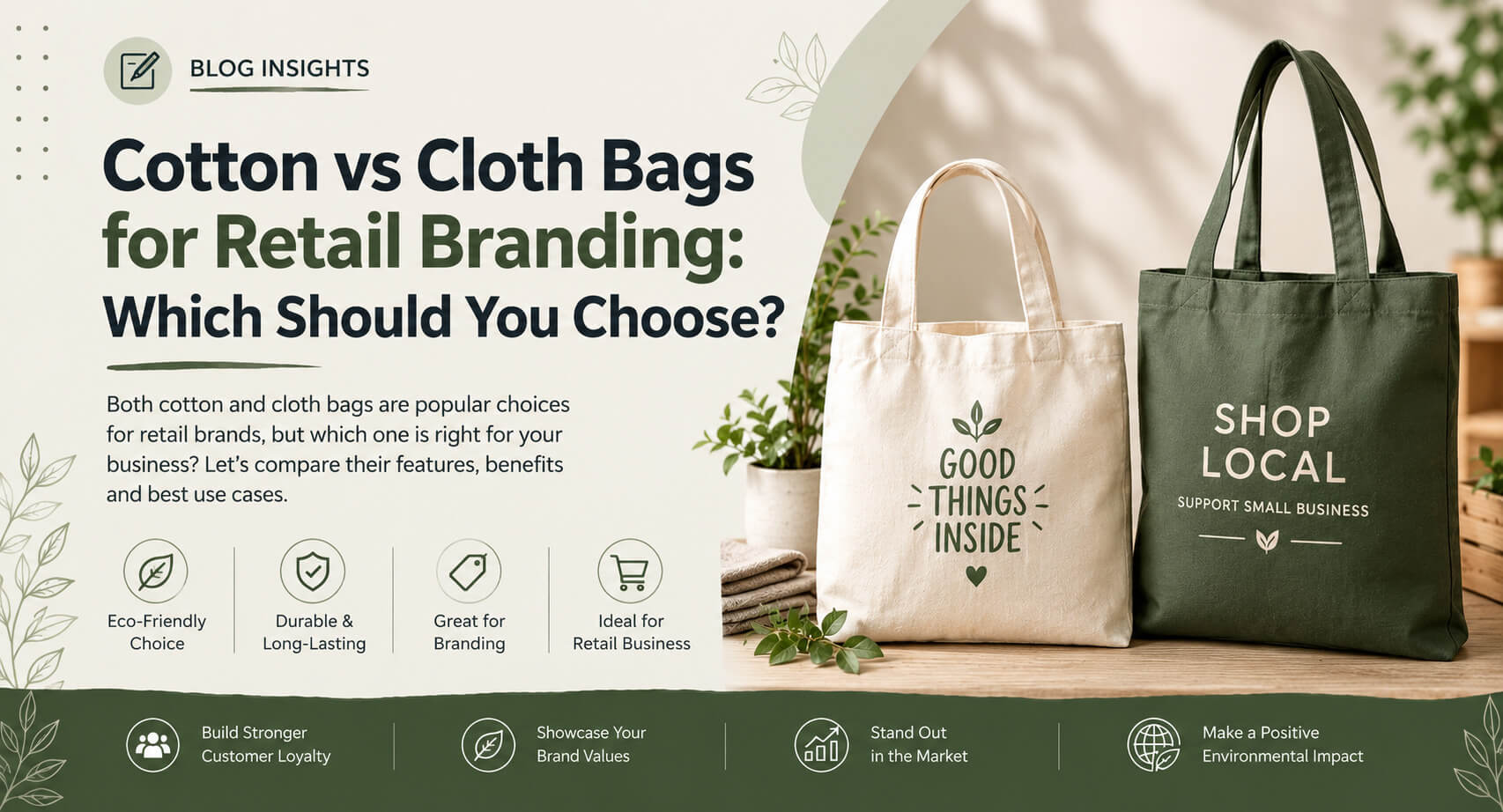
A shopping bag may only be carried for a few minutes… but a well-designed branded bag can keep promoting your retail business long after the customer leaves your store.
That is one reason reusable bags have become an important part of retail packaging.
But when you start comparing suppliers, you quickly come across different terms… cotton bags, cloth bags, fabric bags, canvas bags, non-woven bags, and more.
So what exactly is the difference between cotton and cloth bags?
And which one makes more sense for retail branding?
The answer depends on what you are selling, how you want your brand to look, how often the bag will be reused, and what your budget allows.
This guide breaks down the differences so retailers can make a more informed packaging decision.
What Is a Cotton Bag?
A cotton bag is a reusable bag made from cotton textile.
Cotton is a natural fibre and is commonly used for shopping bags, tote bags, promotional bags, gift bags, and retail packaging.
The exact characteristics of a cotton bag depend on the fabric construction and specification.
Important factors include:
- Fabric weight
- Weave
- Bag dimensions
- Handle construction
- Stitching
- Printing method
- Finishing
- Required load capacity
A lightweight cotton bag can feel very different from a heavier cotton canvas-style bag.
So simply asking for a “cotton bag” is not always enough when placing a commercial order.
What Does “Cloth Bag” Mean?
Cloth bag is a broader term.
It generally refers to a bag made from fabric or textile material, but the word itself does not identify a specific fibre.
A cloth bag may be made from cotton, polyester, blended fabric, canvas, or another textile depending on the supplier and product specification.
That means cotton is a material, while cloth is a broader description of the bag or fabric construction.
This distinction is important when comparing quotations.
Two suppliers may both say they offer “cloth bags” while supplying bags with completely different materials, weights, construction, and prices.
Always ask what the fabric actually is.
Cotton vs Cloth Bags: The Quick Comparison
| Factor | Cotton Bags | Cloth Bags |
| Material definition | Specifically cotton | Broad term covering different fabrics |
| Feel | Depends on cotton fabric weight and weave | Varies significantly by material |
| Branding | Suitable for many printing methods | Depends on fabric |
| Appearance | Often natural and textile-focused | Can range from simple to premium |
| Reusability | Suitable for repeated use when appropriately constructed | Depends on material and construction |
| Cost | Varies with cotton quality and specifications | Can vary widely |
| Best for | Retail, gifting, lifestyle, promotional applications | Retail packaging where different fabric options are required |
The most important takeaway is this…
Cotton bags and cloth bags are not necessarily two completely separate product categories.
A cotton bag can itself be a cloth bag.
The real comparison should be between the specific materials and specifications being offered.
Also Read: Custom Packaging for Local Businesses in Mumbai: Why It’s Worth the Investment
Why Do Retailers Use Fabric Bags for Branding?
A branded retail bag travels beyond the store.
A customer may carry it to work, use it for another shopping trip, keep it at home, or reuse it for everyday purposes.
That gives the brand additional visibility.
Unlike packaging that immediately goes into a bin, a reusable fabric bag has the potential to stay in circulation for longer.
But that potential depends on whether customers actually want to reuse it.
Design matters.
Quality matters.
And practicality matters.
A bag that looks good but cannot comfortably carry the intended products is unlikely to become useful after the original purchase.
Cotton vs Cloth Bags for Different Retail Businesses
Fashion and apparel stores
Cotton or heavier fabric bags can complement a premium retail presentation.
Jewellery stores
A smaller, carefully finished fabric bag can reinforce a boutique experience.
Bakeries and food retailers
The priority may be convenience, suitable dimensions, and easy carrying rather than a highly elaborate bag.
Bookstores
Strength and comfortable handles can become particularly important because books can add considerable weight.
Gift shops
Custom shapes, colours, and branded artwork can make the bag feel like part of the gift experience.
Events and promotions
The priority may shift towards quantity, branding visibility, and budget.
There is no universal fabric choice.
The application should lead the decision.
Cotton vs Cloth Bags… Which Should You Choose?
If you want the shortest possible answer…
Choose based on specification, not terminology.
If your supplier offers a cotton bag that matches your required dimensions, fabric weight, construction, branding, and budget, cotton may be the right choice.
If you need a different textile material or construction, a broader cloth bag specification may give you more flexibility.
The important thing is to compare the actual product.
Not just the label.
Conclusion
The cotton vs cloth question sounds straightforward until you start looking at actual packaging specifications.
A cotton bag can be a cloth bag.
A cloth bag does not necessarily tell you what fibre it contains.
And neither term, by itself, tells you whether the finished bag will be right for your retail business.
The better approach is to start with your products, customers, brand, and budget… then specify the fabric, dimensions, construction, handles, printing, and finishing around those requirements.
For retailers that want custom packaging without treating every bag as a generic product, Bag Bee brings manufacturing experience across cotton, cloth, jute, non-woven, paper, and other bag categories. The company works with businesses that need branded packaging for retail, gifting, bakery, food, and other applications.